

Ground Monitoring for Dike Reinforcement, Gorinchem to Waardenburg – Heijmans Case Study
Gorinchem and Waardenburg, The Netherlands
Project duration: 2021 – 2025
Between 2021 and 2025, the dike between Gorinchem and Waardenburg will be raised, widened, and reinforced over a total length of 23 kilometers. Traditionally, surveyors measure the embankments to maintain control during construction. However, the greasy clay soil makes this work physically demanding and not without risks, including collision and tripping hazards.
With a focus on increasing safety and embracing innovation, the Locator One proved to be the ideal solution for this project.
Locator one units
%
reliable measurement results
Minutes logging time
In control of dike quality.
For this project, over 300 settlement rods equipped with Locator One devices have been installed. But how does the system work?
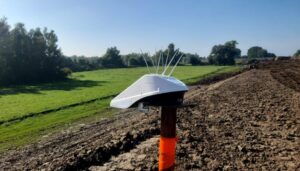
Each settlement rod consisted of a two-meter steel tube with a flat steel base plate, approximately 70 by 70 centimeters, at the bottom. A short tube extended from the underside of the plate and was pushed into the ground to provide stability. The purpose of the settlement rod is to measure the expected slumping and settlement caused by raising the dike.
Reliable predictions: accurate settlement data improved confidence in dike quality and stabilization planning.
Improved safety: automated monitoring reduced risks for workers.
Sustainable execution: fewer site visits lowered traffic movements and CO₂ emissions.
Before construction began, various tests and soundings were conducted on the dike to gain insight into the subsurface layers. Using this data, the geotechnical engineer performed strength calculations to predict expected settlements and deformations.
The more reliable the measurements, the better the predictions could be validated, giving the client greater certainty about the quality and stability of the dike.
Millimeter Accuracy
For this project, a Locator One was mounted on top of each settlement rod to automatically determine the height of the ground plate and, with that, the original ground level. After installation and initial measurements, the contractor could start applying additional soil and sand.
The Locator One performed daily measurements of the vertical movement of the original ground level, as well as the level and thickness of the added soil layers. The thickness of these layers was determined using a calibrated radar sensor that measures the distance between the Locator One and the top of the applied sand or soil.
The automated sensor determined the exact position of the settlement rod with an accuracy of up to 5 mm in the Z direction and 3 mm in the X-Y plane. The Locator One delivered high precision and reliability, with at least 95% of planned measurements resulting in dependable data.
“A year ago, we didn’t know exactly what benefits applying the Locator One would bring, but we were looking for innovative and safer measurement methods. We invested in this concept together because we believed in it. Now, in the realization phase, we can see what it delivers.”

Reliable Prediction
Raw measurement data were received in the cloud environment and processed in the Basetime computing environment to generate reliable coordinates and other information required by the geotechnical department.

The data were then linked to the geotechnical management system via an API, allowing engineers to analyze all information directly from their desks. Optionally, the data were also visualized through a dashboard. By combining accurate data at predefined moments in time, the geotechnical engineers were able to make more reliable predictions of expected settlement and the remaining time until stabilization. This enabled better optimization of overall project planning and logistics.
Safe and Sustainable
Besides accuracy and predictability, safety was a third key advantage of this innovative measurement approach. Where surveyors traditionally carried out on-site measurements, this task was taken over by the Locator One in the field. As a result, the number of people present on the construction site was significantly reduced, directly improving site safety. In fact, the deployment of the Locator One resulted in up to 25 times fewer personnel movements on the construction site.

A fourth advantage was sustainability. Fewer site visits meant fewer traffic movements and, consequently, lower CO₂ emissions. Surveyors no longer needed to travel back and forth between measurement locations, except when settlement rods had to be extended to remain above newly applied soil layers. In addition, the Locator One was equipped with a solar cell and supercapacitor, eliminating the need for disposable batteries and further reducing CO₂ emissions over the lifetime of the project.
Get in touch
We are ready to hear from you! Leave your details here, and your industry expert will be in touch soon.